Out West
A wartime memory by Des Walsh
I don’t think the Japanese would have bombed a dairy farm.
That’s what I thought at the time, or what I think I thought. It’s hard to know, at this distance, what belongs to the four-year-old and what belongs to the old man looking back at him. But that was the logic of it, as best as I can reconstruct it. We had gone west to Werrington to escape the Japanese, and even then, some part of me suspected they had better things to do than bomb a paddock full of Herefords out past Penrith.
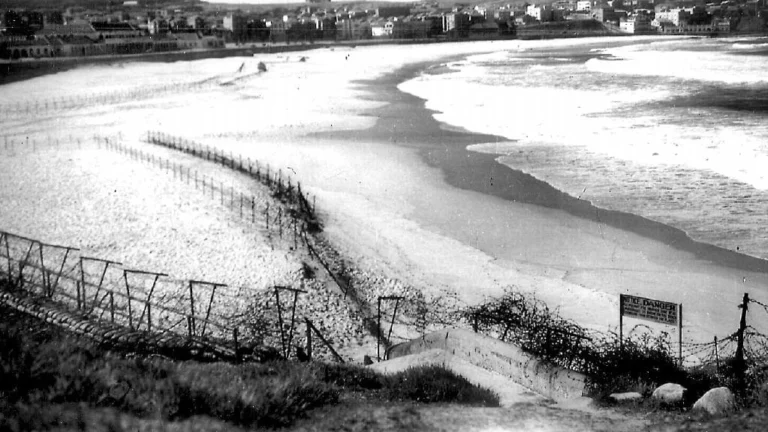
After the submarines came into the harbour and the shells landed in the eastern suburbs, the fear took hold properly. Not in our house, not in any way my parents showed us. But you could feel it in the neighbourhood the way you feel a change in weather before it arrives. Families were leaving. Going west, going inland, putting distance between themselves and the coast. My parents made their own calculation and arrived at Werrington.
My uncle had a place out there. A small dairy farm on the flat western plain, the kind of country that feels like a different world from Coogee, no salt in the air, no sound of surf, just flat light and the smell of grass and cattle and the big sky going on forever. When the family needed somewhere to go, it was where we went.
My uncle had dug a shelter out behind the house. About a metre deep, lined roughly, big enough for half a dozen people pressed together. I remember looking down into it. It smelled of turned earth and had a kind of seriousness about it, the weight of what it implied.
It just sat there. Nobody ever got into it.
There was also a rifle. An old .303 kept at the back of the house, handed out to men across the country in those years as a gesture toward civil defence. I don’t know that my uncle had ever fired it. It had no ammunition, which rather settled the question of what use it would have been. I wanted to touch it, of course. I was four years old and there was a rifle and I had been to the pictures. I was not allowed near it, which felt like a very great injustice.
The logic of the whole arrangement did not entirely convince me. The Japanese had aeroplanes and submarines and had sunk some very large ships. An old .303 with no ammunition and a hole in the ground behind the house seemed an unequal response to all of that.
But nobody asked me.
My parents were exactly as they were in Coogee. My father with the same composure, the same complete absence of visible fear. My mother managing, as she always managed. The milk still needed collecting. The boys still needed feeding. The world that had not ended continued not to end, day after day, with the flat western light coming in the windows and the cattle moving slowly in the paddock and the shelter in the yard waiting for a catastrophe that never came.
We came home because the lease on the house in Coogee came due. Whatever calculation my parents had made about the Japanese and the coastline, the lease came due and the numbers worked out the way they worked out. You pack up the boys and catch the train and go home.
I’ve thought since about that shelter. About a man digging a hole in his own paddock because the world had come to the point where that seemed like a reasonable thing to do. Doing it carefully, doing it properly, knowing it probably wouldn’t save anyone from anything but doing it anyway, because when you cannot control events you do what you can with what you have.
The shelter sat there and nobody used it, and the war moved elsewhere and eventually ended, and the paddocks at Werrington were later swallowed by suburbs. But I remember looking down into that hole in the ground when I was four years old, the smell of the turned earth, the serious quiet of it.
Some preparations are made to be unnecessary. That doesn’t make the making of them foolish.

Des Walsh
Business coach and digital entrepreneur. With coach training from Coachville.com and its Graduate School of Coaching, and a founding member of the International Association of Coaching, Des has been coaching business owners and entrepreneurs for the past 20 years. Over the same period he has also been actively engaged in promoting the business opportunities of the digital economy. He is a certified Neurolinguistic Programming (NLP) coach, and a certified specialist in social media strategy and affiliate marketing.