The Barbed Wire on the Beach
A wartime memory by Des Walsh
People don’t believe me when I tell them about the barbed wire on Coogee beach. They look at me like I’m misremembering, or confusing it with something I saw at the pictures. But I saw it. I walked through it. There was a gap left open like a gate, and you went through single file, and on either side the wire ran all the way down to the waterline. I was four years old, maybe five, and it seemed to go on forever.
But I’m getting ahead of myself.
I was born in June of 1937, the third of the Walsh boys, in Coogee. My father Lou was a Labor man to his bones. He’d joined the party as soon as they’d have him, probably standing on a street corner somewhere listening to some bloke on a soapbox when he was fourteen. He was a teacher, a union man, a councillor in the making. Politics was the water we swam in at home. It was at the dinner table, it was in the conversations my parents had after they thought we were asleep. I absorbed it without knowing I was absorbing it, the way you absorb everything when you’re small.
Coogee was the whole world to me then. The beach, the headlands, the walk up to the shops. The smell of salt and fish and somebody’s frangipani hanging over a front fence. I didn’t know there was a war on, not really. My parents made sure of that. I want to make this point clearly, because I think it matters: my parents never showed any sign of fear. Not once. There was every reason in the world for them to be frightened, and they chose not to show it to us boys. Looking back, I think that was a remarkable thing they did for us. We should have been scared. We just weren’t.
I have a memory, though I’m not sure how much of it is mine and how much came later from talking to my brothers, of standing outside a house in Byron Street, opposite the public school. Someone was walking up the street and stopped and looked at me standing there by myself, this little boy on the footpath, and apparently found it amusing. I would have been about four. I don’t know what I was doing there. That’s how memory works when you’re that young. You get a frame, sometimes just a fragment of a frame, and no story around it.
The night the Japanese came into the harbour, I was asleep.
It was the thirty-first of May, 1942. Three midget submarines had slipped through the defences under cover of dark. One of them fired torpedoes at an American cruiser, the USS Chicago. Both missed. But one torpedo ran on and struck the HMAS Kuttabul, a converted ferry moored over at Garden Island, and broke her in two. Twenty-one sailors died in the water that night.
People have asked me if I remember the explosion. I don’t. Not that night. But I remember something in the days after, a change in the air in our house, something in the way the grown-ups talked to each other and then stopped talking when we came in. You notice that as a child. You file it away.
A week later, on the eighth of June, a Japanese submarine surfaced off the coast in the dark and shelled us directly. Nine shells came in over the eastern suburbs. One struck a house in Woollahra. Others came down near Rose Bay. The whole coastline was awake that night, lights going on in windows, people out in the streets in their dressing gowns looking east toward the sea.
I was told about this more than I remember it. But I know the fear that followed was real, because it changed things. People left. Property prices in the eastern suburbs dropped away sharply. Families packed up and went west, out past Penrith, some of them all the way beyond the Blue Mountains, as if putting the Great Divide between themselves and the ocean would save them. The Japanese had come into the harbour. The harbour. It wasn’t theoretical any more.
My own family went to Katoomba for a while, or somewhere out that way. I have a vague memory of it, a different house, a different smell, the cold of the mountains. As best as I can reconstruct it, talking to my brothers over the years, Mum and Dad had moved us up there to get away from what seemed like an impending invasion. The Repulse had been sunk. The Prince of Wales too, both of them down off Malaya. The barrier between Japan and Australia was gone, and Darwin was being bombed, and nobody was confident anymore about what came next.
We came back to Coogee because the lease on the house came due.
I’ve always found that both funny and quietly profound. The Japanese were at the door and my parents made a domestic calculation about rent. Life has a way of insisting on its own logic. You can’t stay frightened forever. The washing still needs doing.
It was after we came back that I remember the beach.
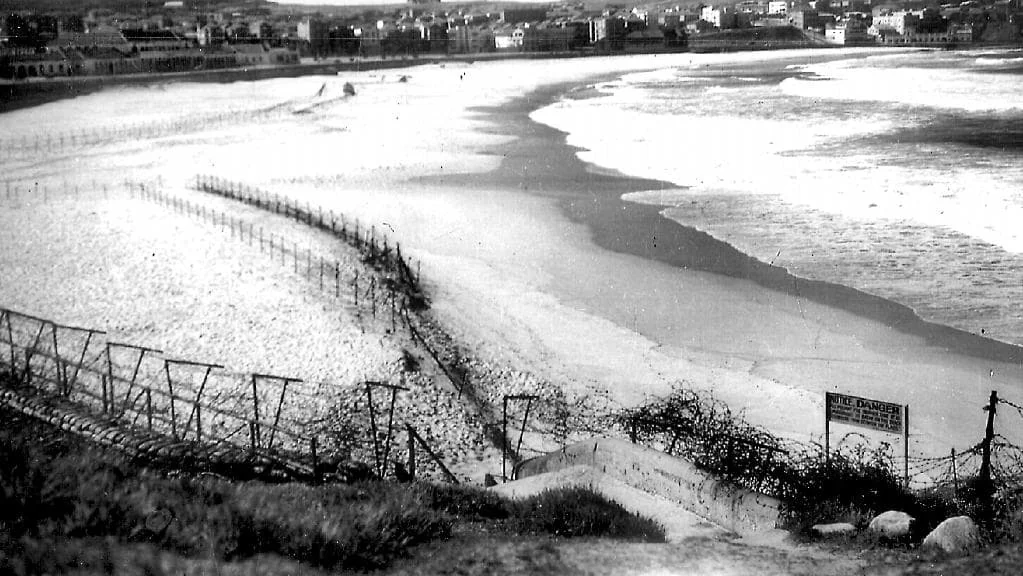
They had strung barbed wire along the sand. Not just Coogee. All of the eastern beaches, from what I understand now. Bondi, Bronte, Maroubra. The whole coastline treated as a potential landing ground, which it was. Because nobody could be sure it wasn’t.
Up on the headlands they had built concrete positions, pillboxes looking out to sea. Sandbags. Men with field glasses. The familiar shapes of the headland I’d grown up looking at were different now, hardened, purposeful. The beach where I played was part of a military installation. That’s not a phrase a four-year-old would have used, but that’s what it was.
You walked through the gap in the wire to get to the water. Single file, like I said. And you played, because children play regardless, and then you walked back through and went home for tea. That was just how it was. We were used to it.
There were Americans in Sydney in those years. I remember them. Big men, well-fed, with more money than anyone around us seemed to have, and they’d give us kids chewing gum and sweets, a fistful of candy, just like that. I thought they were marvellous. The American influence in Sydney was strong. You felt it everywhere. And they were our allies, which I understood even at that age in some vague way. They were the good ones.
My uncle Jim had been in the islands with the army. He came home to my grandmother’s house, and there was a day when he was about to take his shirt off to show my mother and the others his wounds. I was there, small and quick, trying to get a look before I was sent out. They shooed me away. I remember being annoyed about that. Children have a fascination with these things. You see it at the pictures, you hear about it, and when there’s a real wound in the room you want to see it. I never did see it. But I knew it was there.
He’d been found left for dead in an ambush. An Australian patrol had come through, and one of them had nudged him with his boot and said, this one’s gone. But he wasn’t gone. He’d survived with bad wounds and come home to Coogee and sat in my grandmother’s kitchen, alive, and that was what the war looked like close up. A man at a kitchen table who had nearly not come back.
Life went on in that way that life does. There was rationing. I remember going into a shop on the street and seeing a sign on the wall: one pat of butter per person. You got your pat of butter, and that was your lot. My mother was ingenious about these things, resourceful in the way that women of that generation and that circumstance had to be. She managed. She always managed.
I went to school. We played on the beach through the wire. I listened to my father talk about the union, about the council, about the party. The war was a thing on the horizon, literally and figuratively. It had come close enough to touch us, and then it pulled back, and we were still here.
I was born the year before the war began. It was the worst war the world has ever seen. It killed millions of people, and it reshaped everything, and it lapped at the edges of my childhood without quite swallowing it. My parents made sure of that. They kept their fear to themselves, and gave us their composure instead.
I’ve been grateful for that my whole life.
But when I tell people about the barbed wire on Coogee beach, they don’t believe me. And I say: I walked through it. I was there. The war was right there, on the sand where we played, on the headland where they’d poured the concrete and pointed the guns out to sea.
It was that close.
(Photo of WW2 Bondi Beach courtesy of Major Johnston Photograph Collection)

Des Walsh
Business coach and digital entrepreneur. With coach training from Coachville.com and its Graduate School of Coaching, and a founding member of the International Association of Coaching, Des has been coaching business owners and entrepreneurs for the past 20 years. Over the same period he has also been actively engaged in promoting the business opportunities of the digital economy. He is a certified Neurolinguistic Programming (NLP) coach, and a certified specialist in social media strategy and affiliate marketing.